
What Is a Corrupted PDF File?
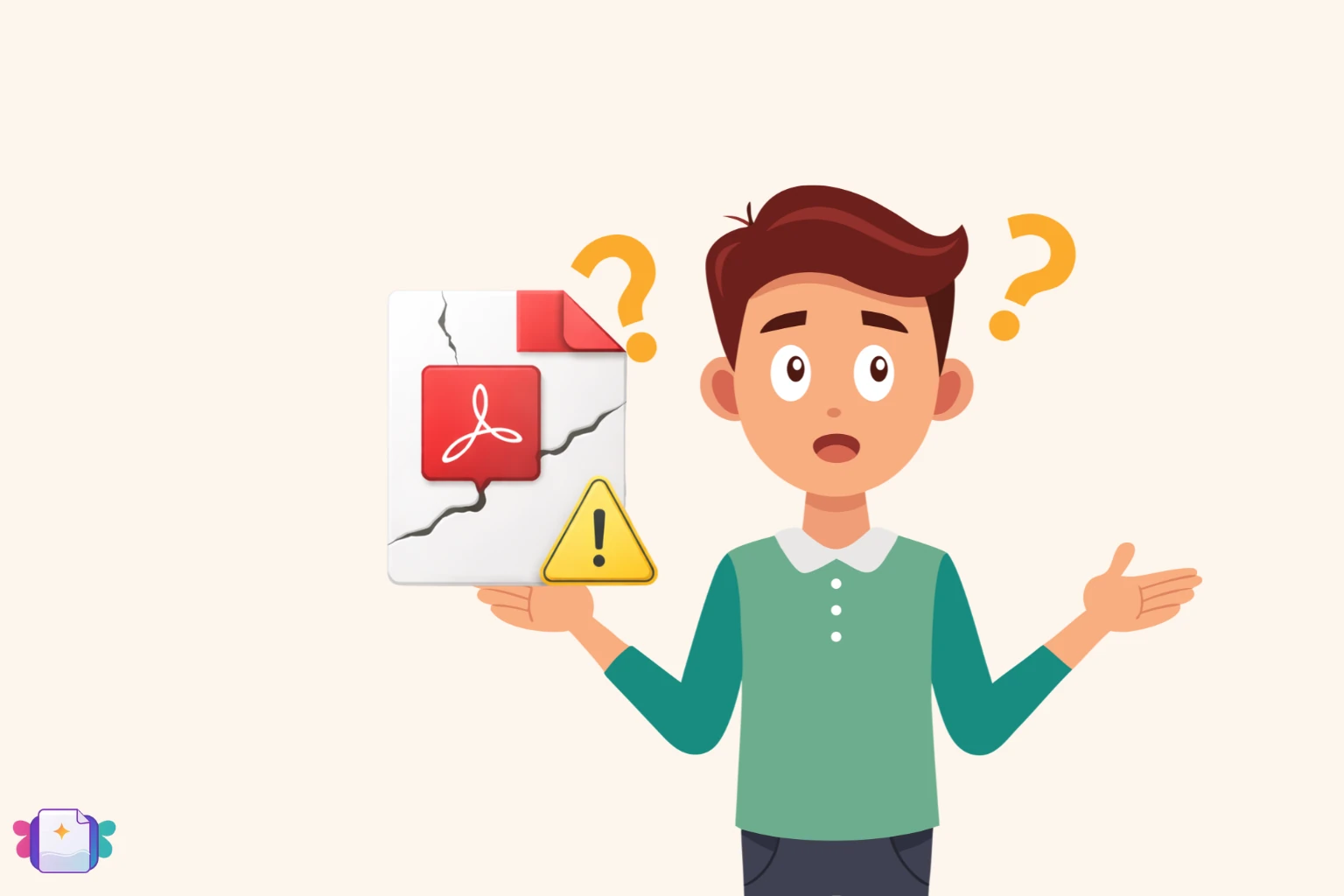
A corrupted PDF is a file whose internal binary structure has been damaged to the point where PDF viewers can no longer parse it. It might look completely normal in your file browser — correct filename, right extension, reasonable file size — but the moment you try to open it, every application that handles PDFs returns the same result: an error.
Understanding what actually happens inside a corrupted PDF explains why some files can be repaired while others can't, and why intentionally creating one for testing purposes produces a reliably broken result across all platforms.
In short
- ✔ A corrupted PDF has damaged internal structure — not just a wrong extension
- ✔ Causes include interrupted downloads, storage errors and failed conversions
- ✔ Repair is sometimes possible, depending on how much data is intact
- ✔ You can create a corrupted PDF intentionally for testing — online, in seconds
What actually happens inside a corrupted PDF?
Every PDF file follows a strict internal format. It starts with a file header — the %PDF-1.x signature that tells viewers they're dealing with a PDF. Then comes the body, which contains all the content objects: text streams, images, fonts, page definitions. A cross-reference table maps the position of each object in the file so the viewer can navigate directly to them. Finally, a trailer section ties everything together.
When any of these components is missing, truncated, or overwritten with invalid data, the viewer can't parse the file. It doesn't matter if the rest of the content is perfectly intact — if the cross-reference table is broken, the viewer can't find the objects. If the header is missing, it doesn't recognize the file as a PDF at all.
This is what distinguishes a corrupted PDF from a file that simply won't open for other reasons. A password-protected PDF opens fine and asks for a password. A PDF created in a newer version might have compatibility issues. But a genuinely corrupted PDF fails at the structural level — the file is there, but it's broken from the inside.
Common causes of PDF corruption
PDF corruption usually happens at one of three moments: during transfer, during storage, or during creation.
Interrupted download or transfer
If a file download or network transfer is cut short, the saved copy is missing its final bytes. The file exists on disk but is incomplete — which typically means the trailer section and parts of the cross-reference table are absent.
Storage hardware failure
A bad sector on an HDD or SSD can overwrite specific bytes of a file with garbage data. This type of corruption is unpredictable and can affect any part of the PDF structure, from the header to the content streams.
Failed conversion or export
If a PDF converter or export tool crashes or is forcibly closed mid-process, it may write an incomplete file. The resulting PDF might appear to have been created successfully but fails to open because the writing process never completed.
Can a corrupted PDF be repaired?
Sometimes. PDF repair tools work by scanning the raw binary data for intact content objects — text streams, images, fonts — and attempting to reconstruct a readable document from whatever is salvageable. The success rate depends heavily on what was damaged. A file that's only missing its trailer section is often fully repairable. A file where the content streams themselves are overwritten may only recover partial content, or nothing at all.
If you've intentionally corrupted a PDF for testing purposes and now need the original content back, the simplest solution is to use the original file again — the corruption tool never modifies what you uploaded, so your source is always intact.
Need a corrupted PDF for testing? You can create one intentionally using CandyFile's corruption tool. Upload any valid PDF, and the tool modifies its internal structure to make it unreadable — producing a reliable broken file for QA, development, or documentation purposes.
Frequently asked questions
Is a corrupted PDF the same as a broken PDF?
Yes — the terms are interchangeable. Both describe a file whose internal structure is damaged enough that PDF viewers can't parse it. “Damaged,” “broken,” and “corrupted” all refer to the same condition.
Can antivirus software cause PDF corruption?
Occasionally. Some antivirus tools quarantine or modify files during download as part of real-time scanning. If the process is interrupted or the tool incorrectly modifies the file, the result can be a truncated or altered PDF that no longer opens correctly.
Will the file still have a .pdf extension?
Yes. Corruption happens inside the binary data of the file, not in the filename or extension. A corrupted PDF looks identical to a normal PDF in your file browser — same name, same icon, same extension. Only when you try to open it does the error appear.
Can I create a corrupted PDF intentionally?
Yes. CandyFile's PDF corruption tool lets you upload any valid PDF and download a broken copy in seconds. The tool alters the file's internal structure in a way that causes every PDF viewer to return an error, making it suitable for testing and documentation purposes.
Need a corrupted PDF?
Create one online in seconds — free, no registration required.
Corrupt PDF — free